Lancang-Mekong Cooperation: A Decade of Shared Home and Deepening Bonds
Source: InKunming | 2026-04-08 | Editor:Doe
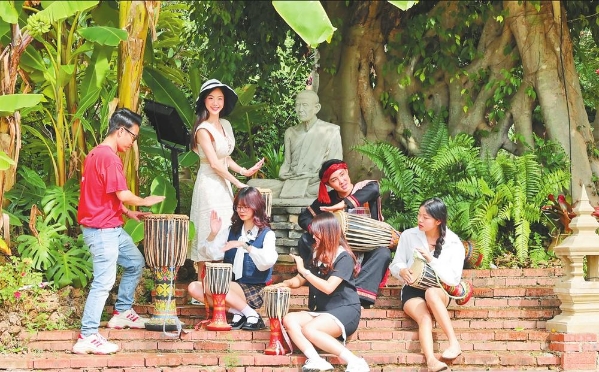
A young Thai singer (second from left) learns the elephant-foot drum from a Chinese intangible cultural heritage inheritor. Photo provided by the Yunnan Center for International Communication for South and Southeast Asia.
In June 2025, Vietnamese youth took part in a themed visit titled “Uncle Ho’s Footsteps in Yunnan” during the China–South Asia Expo. Photo by Chen Chen from Yunnan Daily.
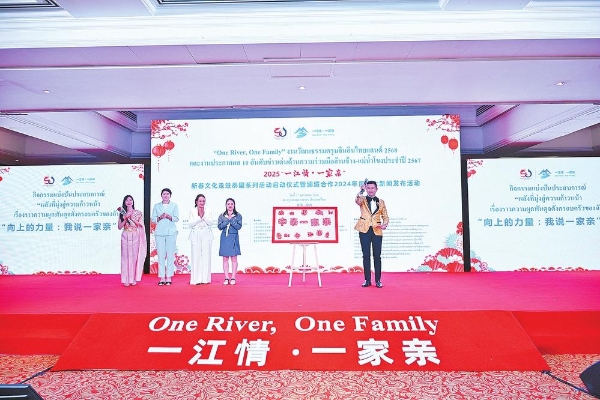
The 2025 “One River, One Family” Spring Festival cultural exchange series was held in Thailand. Photo provided by the Yunnan Center for International Communication for South and Southeast Asia.
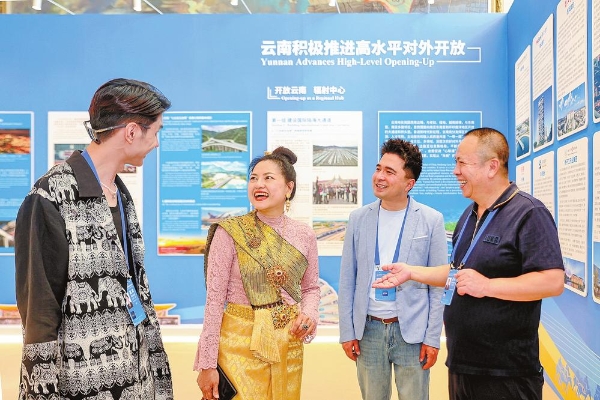
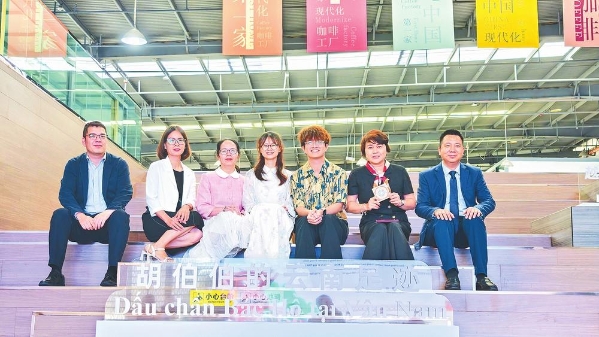
Chen Muyun (second from left), a Thai communication officer at the Yunnan Center for International Communication for South and Southeast Asia, attended the achievements exhibition of the 2025 Belt and Road Media Cooperation Forum. Photo by Chen Fei and Hu Yuya from Yunnan Daily.
This year marks the 10th anniversary of the first Lancang-Mekong Cooperation Leaders’ Meeting.
Launched in Sanya, Hainan, on March 23, 2016, the Lancang-Mekong Cooperation mechanism marked the beginning of a shared commitment by the six countries to solidarity, self-reliance and mutually beneficial cooperation.
Over the past decade, Lancang-Mekong countries have advanced together through good times and bad. Their bonds of shared destiny have grown closer, the momentum for development has strengthened, security safeguards have become more solid, and people-to-people exchanges have become deeper.
Over the past decade, what began as a seed of cooperation has grown into a flourishing tree, making Lancang-Mekong Cooperation a strong example for building a global community with a shared future.
Bound by one river, the countries have become one family. Yunnan, at the forefront of Lancang-Mekong cooperation, has helped write the story of this great river and has itself been nourished by these deep bonds.
Cooperation Mechanisms Continue to Deepen
Lu Guangsheng, dean of the School of International Relations at Yunnan University and director of the Lancang-Mekong Subregional Research Center, said that cooperation between China and Mekong countries has evolved far beyond a single economic dimension. Starting with the Greater Mekong Subregion Economic Cooperation Program in 1992 and developing into today’s Lancang-Mekong Cooperation framework, it has expanded into political affairs, security, social development, and other fields, forming the “3+5+X” comprehensive cooperation framework. In his view, the continuous deepening of these mechanisms has elevated the emotional bond among countries sharing the same river into an institutional guarantee of a closely linked future, laying a solid foundation for deeper cooperation between China, the five Mekong countries and even ASEAN as a whole.
He also highlighted the people-centered agenda under Lancang-Mekong Cooperation. What began as state-led intergovernmental cooperation has gradually extended to all levels of society and entered the everyday lives of ordinary people. More than 7,000 students from Mekong countries are studying in Yunnan, while a series of “small but beautiful” livelihood projects have been launched in rural areas, alongside steadily expanding cooperation in poverty reduction and vocational education.
Looking back on the past decade, Lu said, Yunnan has always been a participant and a driving force in Lancang-Mekong Cooperation, playing an irreplaceable frontline role. Through concrete practice, Yunnan has shown how geographic proximity can be translated into development dividends, making cooperation not only strategically significant but also people-centered. “At this new starting point, we look forward to Lancang-Mekong Cooperation 2.0, one that will write an even more remarkable chapter in building a shared future with neighboring countries,” he said.
Language Builds a Bridge for Communication
Myanmar diplomat Sarah Monsanpan shared that, for a long time, Lancang-Mekong Cooperation was simply a term that appeared frequently in work documents and a key topic at meetings, yet it still felt somewhat distant. “It was only after I came to Yunnan to study Chinese that it all began to feel real,” she said.
She recalled that the first time she tried to buy fruit in Yunnan, she struggled to make herself understood despite gesturing for quite a while, becoming so anxious that she broke into a sweat. Fortunately, a kind local woman helped her out with simple words and gestures. In class, she diligently studied pronunciation and grammar, progressing from basic phrases such as “hello” and “thank you” to confidently communicating with her classmates. To her, the process felt like building a bridge of communication with her own hands. “Through the bridge of language, I have truly entered Chinese daily life and experienced people’s warmth, kindness, and sincerity. At the same time, I have also been able to tell Chinese friends about Myanmar,” she said.
Sarah said she recently learned a saying: “One more friend means one more path; one more language means one more window.” She added, “To young people in all six Lancang-Mekong countries, I’d like to say this: let all of us become bridge-builders, using language as a bridge to create a better future for the Lancang-Mekong region together.”
In Yunnan, There Are Always More Doors to Knock On
In recent years, Chen Muyun, an overseas communication officer at the Yunnan Center for International Communication for South and Southeast Asia, has been involved in filming the Thai-language micro-documentary “Come On, Let’s Pay a Visit” while also taking part in a wide range of cultural exchange activities and visiting the homes of different families in Yunnan.
Thanks to these visits, she says she now seems to have endless festivals to celebrate. In February last year, she celebrated the Chinese Lunar New Year in Yunnan together with local people. In October, she traveled to Lvchun County in the Honghe Hani and Yi Autonomous Prefecture to attend the Hani long-table banquet, where more than a thousand tables stretched along the streets and guests from all directions seated together in a truly spectacular scene.
Chen said that through these visits, she has witnessed many fascinating moments. At a rice noodle shop in Mengzi, she learned that the owner starts simmering the broth at 3 a.m. and can sell more than 1,000 bowls a day. At a Winona factory, she discovered that this homegrown Yunnan cosmetics brand has already entered the Thai market. She also returned to Ayutthaya in Thailand and showed Chinese internet users around her hometown.
She said that with the China-Thailand railway gathering pace, it may not be long before one can enjoy a bowl of rice noodles in Kunming in the morning and return to Bangkok for a late-night meal the same evening. “When that day comes, I will still keep coming back to Yunnan again and again,” she said. “Because through each visit, I’ve not only come to know Yunnan, but also gradually turned the life I once dreamed of into work I truly love. And in Yunnan, there are always more doors to knock on, more festivals to celebrate, and more stories to film.”
The China-Laos Railway Connects the Heartlands of Two Countries
Anoud Peikaysone, deputy general manager of Laos-China Railway Co., Ltd., said that Laos is the only landlocked country in Southeast Asia, and its geography has long been constrained its socioeconomic development. When the China-Laos Railway officially began operation in 2021, it created entirely new opportunities for Laos, helping the country transform from a “landlocked country” into a “land-linked country” and ushering it into a new era of connectivity.
More than four years on, the railway has become a major engine driving Laos’s continued development across multiple sectors. Transport costs between Vientiane and Kunming have fallen sharply, and logistics efficiency has improved significantly, providing considerable convenience for business cooperation and exchanges between the two countries. Areas along the railway have also become investment hotspots, with new logistics hubs and industrial parks continuing to emerge.
Anoud said that Laos-China Railway Co., Ltd. will further enhance operational efficiency and strengthen talent development in related fields. He said he firmly believes that as Laos and China continue to deepen cooperation in logistics, trade, infrastructure facilitation, and industrial integration, this “golden corridor” will become a solid platform for shared regional prosperity, promoting both the smooth flow of goods and closer people-to-people ties.
Creating a Shared Green Future
Nguyen Thi Nhu Van, a lecturer at the Faculty of Industrial and Energy Management of Electric Power University of Vietnam, said that Vietnam is accelerating its green energy transition. The Vietnamese government has approved a new energy development roadmap aimed at expanding renewable power generation capacity and reducing carbon emissions. This has created opportunities for Vietnam and China to cooperate in solar power, wind power, smart grids, and cross-border electricity transmission. Such cooperation will support sustainable development and strengthen regional energy connectivity.
“Regional integration is also key to achieving a green transition,” Nguyen said. Vietnam is strengthening power grid interconnection with Laos, Cambodia, and China in order to broaden its energy supply channels. Vietnam also plans to substantially expand its solar and wind power capacity, which will help optimize the use of renewable energy and reduce carbon emissions.
Nguyen noted that manufacturing accounts for nearly a quarter of Vietnam’s GDP, making a stable energy supply vital to the sector’s development. Cooperation between Vietnam and China in ultra-high-voltage power transmission and smart grids has improved infrastructure performance, helped enhance Vietnam’s regional standing, and supported the broader development of the ASEAN power market. This model provides a valuable reference for cross-border trade in renewable energy, contributing to green and low-carbon development while promoting economic growth.
“Loving Heart Journey” Leaves a Warm Mark
For many years, Yunnan Fuwai Cardiovascular Hospital has carried out the “Loving Heart Journey” program in Cambodia, providing screening and free medical consultations for children with congenital heart disease. Oeun Thy, deputy governor of Banteay Srei District in Siem Reap Province, Cambodia, has visited many schools across Cambodia to help children with congenital heart disease travel to Yunnan for treatment. In his view, the “Loving Heart Journey” program is the warmest and most moving expression of Lancang-Mekong Cooperation.
Oeun Thy recounted the story of a Cambodian child named Peng Sela. Peng traveled to Kunming for treatment in 2018 and is now a university student. In 2025, Oeun Thy returned to Kunming with Peng to take part in a Yunnan visit for recovered children under the China-Cambodia “Loving Heart Journey” program. During the trip, Peng had the chance to express his gratitude in person to the doctor who treated him years earlier. “When I saw their smiles at the reunion, I truly felt that love and kindness can cross national borders,” Oeun Thy said.
Oeun Thy said that the “Loving Heart Journey” program is not only a medical assistance initiative, but also a bridge of friendship connecting the people of Cambodia and China. It helps children grow up healthy and brings new hope to countless Cambodian families. He expressed the hope that the two countries will continue working hand in hand to make Lancang-Mekong Cooperation a source of care and warmth. (Reporters: Han Chengyuan, Liu Ziyu, and Wang Jingzhong)
Click here to view the Chinese report
(Editors: Rachel, Doe)
You May Like
-
A Letter from Kunming | Kunming Invites the World to Celebra...
As the Chinese New Year approaches, the international communication series event "A Letter from Kunming" warmly commences.
InKunming 2026-02-13 -
Why Yunnan is winning hearts worldwide
Drawn by good weather, dramatic landscapes and a mix of cultures, foreigners from across the globe are building their lives in this idyllic corner of China, Yan...
InKunming 2026-02-09 -
China-Laos 500-kV power interconnection project achieves ful...
The Chinese and Lao sections of the China-Laos 500-kV power interconnection project were physically connected on Thursday, marking a major step forward in bring...
InKunming 2026-02-06 -
Foreign diplomats hail Yunnan's opening-up efforts
Diplomats from South and Southeast Asian countries have lavished praise on Yunnan's opening-up efforts during the 14th Five-Year Plan period (2021-25), while lo...
InKunming 2026-02-02 -
Yunnan Expands Cultural and Tourism Offerings, Boosting Cons...
Flights from cities like Beijing, Tianjin, and Shanghai to Yunnan are in high demand, and Kunming ranks among the top inbound tourism destinations... Behind the...
InKunming 2026-01-06 -
Beyond Sightseeing: Embracing a Life Within the Scenery
In Yunnan, warm winter sunshine has become a commonplace attraction in many areas, drawing numerous sojourners.
InKunming 2026-01-04 -
Trains, Talks, and Coffee: Kunming 2025 Yearender
Over the course of a single year, Kunming has undergone a profound transformation—from a geographic transit hub to a platform for ideas, and from a stopover ci...
InKunming 2025-12-31 -
Kunming police dog is now a natl all-rounder
Every morning, senior police dog trainer Long Ling walks into a kennel on the outskirts of Kunming, Yunnan province, greeting a Kunming dog named Kun Kun with a...
InKunming 2025-12-28 -
Kunming-SCO Marathon: A Decade of Shared Journey
This winter, the warmth of Kunming comes not only from the plateau sunshine, but from the surge of heat generated by 26,000 runners gathering in the Spring City...
InKunming 2025-12-01 -
159th joint patrol of Mekong River begins
Law enforcement authorities from China, Laos, Myanmar and Thailand on Tuesday launched their 159th joint patrol of the Mekong River to combat cross-border crime...
InKunming 2025-11-26