Tourism enjoys robust growth
Source: China Daily | 2026-04-07 | Editor:Jennifer

Tourists take photos in front of the Hall of Prayer for Good Harvests at the Temple of Heaven Park in Beijing on Sunday. WANG XIN/FOR CHINA DAILY
As China's visa-free policies continue to deliver dividends, the country's inbound tourism market is warming up this spring, with travelers venturing beyond first-tier cities to second- and third-tier destinations and shifting from traditional sightseeing to immersive cultural experiences.
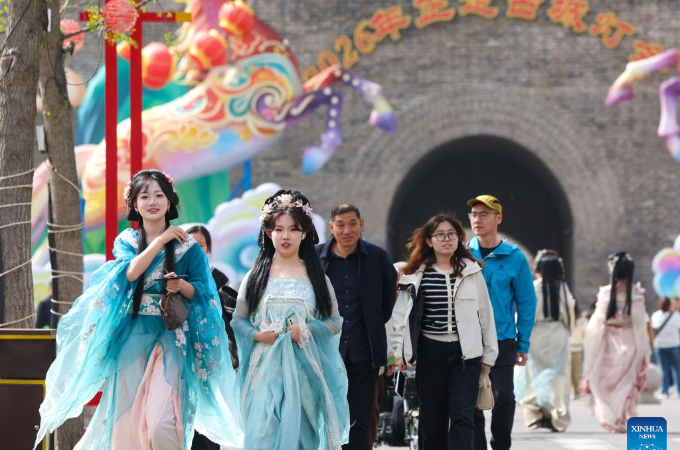
Instead of merely visiting widely popular sites like the Terracotta Warriors or climbing the Great Wall, foreign visitors are stepping into intangible cultural heritage workshops, donning traditional hanfu, learning to make dumplings and even firing porcelain. From "seeing China" to "being Chinese for a day", cultural experiences are emerging as a new engine for inbound tourism.
A short video recently went viral on social media, showing Zhang Shupeng, known as Asia's first wingsuit pilot, leaping from Yuhu Peak at Zhangjiajie's Tianmen Mountain and flying at more than 200 kilometers per hour through Tianmen Mountain Square in Hunan province.
The video, posted by a foreign blogger on Instagram, garnered more than 100 million views and nearly 5 million likes within days, with comments in multiple languages expressing awe.
Ding Yunjuan, deputy manager of the marketing department at Tianmen Mountain Scenic Area, said that the site attracts extreme sports enthusiasts while offering foreign visitors the chance to watch world-class events such as the annual World Wingsuit League Championship, as well as parkour contests and bicycle speed races down the mountain stairs.
The scenic area has also enriched its cultural tourism offerings. Its mountain-gorge theater stages Tianmen Fox Fairy, the world's first live musical performance set in a high-mountain canyon. The show is based on the Xiangxi folk tale The Legend of Woodcutter Liu Hai and centers on themes of oriental love aesthetics.
Between 2024 and 2025, overseas tourists accounted for 60 to 70 percent of the show's audience. In 2025, it received 250,000 overseas visitors, a 45 percent year-on-year increase, covering more than 120 countries and regions. During the first performances of 2026, overseas visitors made up 70 percent of the audience, Ding said.
The scenic area welcomed 162,100 overseas visitors in the first quarter of 2026, a 26 percent year-on-year increase. The top four source markets were South Korea, China's Taiwan, Indonesia and Malaysia, she added.
The park has strengthened English training for its personnel, provided translation devices for front-line employees and introduced guided tours in Chinese, English and Korean.
In Lijiang, Yunnan province, during the Sanduo Festival — a traditional celebration of the Naxi ethnic group honoring the guardian deity Sanduo — two tourists from New York and Los Angeles, Iren Helperin and Soheila Halimi, said they were drawn to the city's ancient town and ethnic culture and praised its safe and friendly travel environment.
"We felt very safe here. As a tourist, safety is very important because you're not familiar with the city or the culture," Helperin said. "In Europe, you have to wrap your phone with a string so if somebody tries to grab it, you can pull it back. Here you don't have to worry. I can carry my phone and take pictures."
A German couple, Evgeni Knispel and Denise Nagel, who were also visiting Lijiang, said they discovered the city while searching online for trips to China. They praised its cleanliness, pleasant weather and well-preserved old town.
"It's unbelievably clean everywhere," Nagel said. Knispel added that while Lijiang is touristy, it is less crowded than destinations in Thailand, and he would recommend it to friends and family.
Lyu Ning, dean of the School of Tourism Sciences at Beijing International Studies University, said that smaller cities preserve more authentic natural scenery and folk customs, meeting foreign tourists' demand for uniqueness and authenticity.
Meanwhile, China's transport and service infrastructure has expanded into lower-tier cities. High-speed rail now reaches third — and fourth-tier cities, including Wuyishan in Fujian province and Huangshan in Anhui province. Regional air networks have improved, while rural tourism roads and scenic area shuttle services have helped solve the "last mile" problem, she said.
"Overseas communication has shifted from official promotion to authentic experience sharing on social media platforms such as TikTok, Instagram and YouTube. Foreign visitors' real-life posts are more influential and relatable than traditional advertising," Lyu said.
On the shift from "seeing China" to "being Chinese for a day", Lyu said it reflects a move from curiosity-driven sightseeing to deeper cultural empathy.
"Young overseas tourists, especially Generation Z, no longer want to just check off landmarks; they want to participate in Chinese daily life," she said.
"This demand change is essentially a shift from knowing China to understanding China," Lyu said. Immersive experiences turn Chinese culture from abstract symbols into tangible, shareable moments, creating a word-of-mouth chain from experience to emotional resonance and then sharing.
Experiential products are becoming the core competitiveness of the inbound tourism market, moving away from resource-dependent models to creativity-driven offerings. They not only enrich the product mix but also increase added value and repeat visits, as tourists form emotional connections and return for specific experiences, she added.
Contact the writers at [email protected]
You May Like
-
Diqing Culture and Tourism Targets South Asia and Southeast ...
On December 20, "Shangri-La of the World: Culture and Tourism Promotion to South and Southeast Asia" was held in Kunming, organized by Culture and Tourism Burea...
InKunming 2024-12-23 -
Discover Wonders of Winter Tourism in Colorful Kunming
When we think of winter, we often picture a season of dormancy—grass turning brown, northern lands blanketed in snow.
InKunming 2024-12-13 -
From Obscurity to Tourism Hotspot: The Transformation of Da ...
In recent years, Da Mo Yu Village and Le Ju Village in Xishan District, Kunming, have successfully attracted numerous travelers to settle down, thanks to their ...
InKunming 2024-11-13 -
Tourism improves villagers' life in SW China's Yunnan
From the 1980s to 1990s, He Jielin and his wife could only live off the land. Like other villagers, the couple made a living by cutting wood, picking medicinal ...
InKunming 2024-04-15 -
Tourism soars in China's Yunnan over 8-day holiday
Yunnan, one of the most popular tourist destinations in China, experienced a significant tourism surge during the Mid-Autumn Festival and National Day holiday t...
InKunming 2023-10-07 -
Tourism revenue of China's Yunnan tops 693 bln yuan in H1
Southwest China's tourism powerhouse Yunnan Province witnessed a robust rebound in tourism in the first half of 2023, data from the provincial culture and touri...
InKunming 2023-07-24 -
Yunnan set to celebrate China Tourism Day
China will celebrate the 13th annual China Tourism Day on May 19 in Tengchong, Yunnan province.
InKunming 2023-04-14 -
Tourism market in China's Yunnan sees robust holiday recover...
Southwest China's Yunnan province posted 45.15 million visits made by tourists during this year's Spring Festival holiday, up 244.7 percent year on year, accord...
InKunming 2023-01-29 -
Tourism summit and development conference highlight district...
Ancient towns flanking the Xiangjiang River make Wangcheng district culturally attractive, which the city and authorities hope will become a cultural tourism mo...
InKunming 2022-11-24 -
Tourism rebounds in Yunnan as epidemic wanes
Scenic sites in southwest China's Yunnan Province, famed for its rich biodiversity, are once again bustling with tourists, thanks to effective containment of CO...
InKunming 2022-07-13