China emerges as key supply hub in ASEAN+3 production network, says regional research institute
Source: Xinhua | 2026-04-07 | Editor:Jennifer
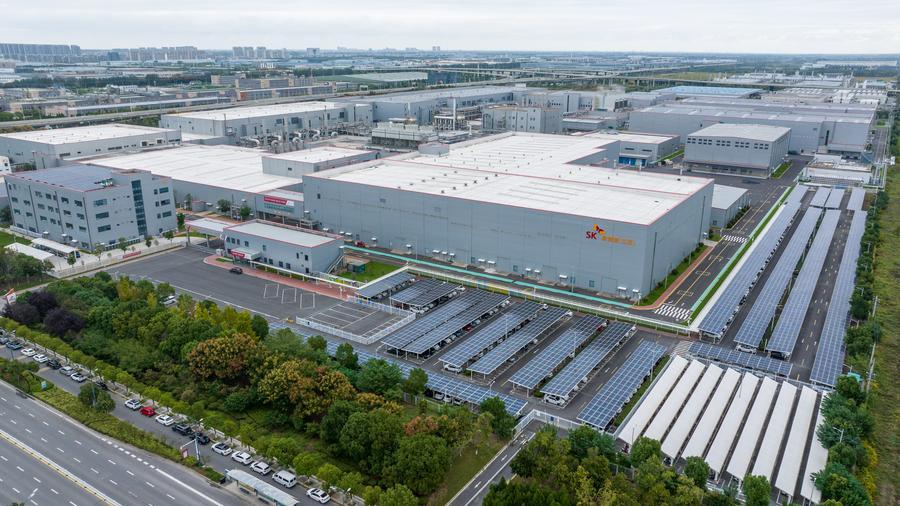
This aerial drone photo shows a view of a new energy battery production base of South Korean EV battery maker SK On Jiangsu Co,. Ltd. in Yancheng, east China's Jiangsu Province, Oct. 16, 2025. (Xinhua/Li Bo)
China has become a primary hub in the production network of the ASEAN+3 region, comprising ASEAN member states plus China, Japan and South Korea, the Singapore-based ASEAN+3 Macroeconomic Research Office (AMRO) said Monday.
The past two decades have seen a fundamental structural shift underpinning the region's resilience, the institute said in its ASEAN+3 Regional Economic Outlook 2026.
"From the supply side, regional production networks have evolved from a Japan-centered hub into a denser, more interconnected architecture anchored by China," it said, noting that this was supported by China's expanding manufacturing capacity, logistics infrastructure, and central position in intermediate goods trade.
"These supply linkages reflect interdependence rather than unidirectional dependence," the report said.
On the demand side, ASEAN+3 has emerged as a major source of global final demand, collectively larger than the United States, with intraregional demand now far more significant than two decades ago.

Staff members work on an inspection line at a workshop of Changan Mazda in Nanjing, east China's Jiangsu Province, March 17, 2026. (Xinhua/Ji Chunpeng)
This relationship is also two-way: within ASEAN+3, China is the dominant demand hub, while other economies are key sources of final demand for Chinese exports, the report noted.
At the same time, foreign direct investment (FDI) reinforced these links, with rising intraregional FDI complementing trade and production relationships, the report said.
During Monday's release conference, AMRO Chief Economist He Dong told reporters that for supply chains to be resilient, it is important for economies involved to increase domestic-value-added content, meaning larger positive spillovers from FDI into the domestic economy.
Firms in ASEAN can benefit by upgrading local capacity. By increasing domestic value-added, regional firms gain more opportunities and make supply chains more resilient to external shocks, He said.
You May Like
-
Cambodia hosts ASEAN climate outlook forum, with focus on he...
The 24th Association of Southeast Asian Nations (ASEAN) Climate Outlook Forum was convened in Phnom Penh, capital of Cambodia, on Thursday, with a focus on he...
InKunming 2025-04-25 -
Malaysia convenes ASEAN emergency meeting on Myanmar earthqu...
Malaysia convened the Special Emergency ASEAN Foreign Ministers' Meeting on Sunday in response to the powerful earthquake that rocked Myanmar, according to a st...
InKunming 2025-03-31 -
China, ASEAN most appealing in Asia for foreign investments:...
Global foreign investments have increased their reliance on Asian economies amid fluctuations, and China and the Association of Southeast Asian Nations (ASEAN...
InKunming 2025-03-25 -
Strengthening China-ASEAN tourism ties through Nanning
Nanning, the capital of South China's Guangxi Zhuang autonomous region, will host the "Global Mayors Dialogue - Nanning" event from Jan 15 to 18, aimed at foste...
InKunming 2025-01-17 -
Guangxi-ASEAN cooperation enhances regional development
Guangxi Zhuang autonomous region is quickly increasing its involvement with ASEAN countries in various sectors, acting as a gateway to the region. This growing ...
InKunming 2025-01-16 -
14th China-ASEAN Defense Ministers' Informal Meeting held in...
The 14th China-ASEAN Defense Ministers' Informal Meeting was held in Vientiane, capital of Laos, on Thursday.
InKunming 2024-11-22 -
Chinese premier to attend 20th China-ASEAN Expo, China-ASEAN...
Chinese Premier Li Qiang will attend the opening ceremony of the 20th China-ASEAN Expo and China-ASEAN Business and Investment Summit in Nanning, capital of Sou...
InKunming 2023-09-25 -
ASEAN summit concludes with fruitful outcomes despite global...
The 43rd Association of Southeast Asian Nations (ASEAN) Summit concluded here on Thursday with a series of outcomes despite rising uncertainties globally.
InKunming 2023-09-08 -
ASEAN countries pledge to strengthen community-building, uni...
The Association of Southeast Asian Nations (ASEAN) members have reaffirmed their commitment to strengthening the ASEAN Community, its unity and centrality at th...
InKunming 2023-09-07 -
43rd ASEAN Summit kicks off in Jakarta, Indonesia
A man is pictured at the venue of the 43rd Association of Southeast Asian Nations (ASEAN) Summit in Jakarta, Indonesia on Sept. 5, 2023. The 43rd ASEAN Summit a...
InKunming 2023-09-05