Rediscovering Kunqu: a bridge across the Strait
Source: China Daily | 2026-03-25 | Editor:Doe
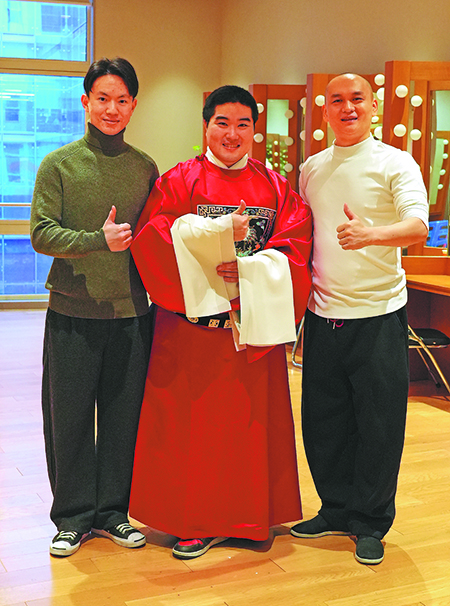
Zheng Tingyi (center) in traditional Kunqu Opera attire poses with fellow performers at a theater in Kunshan, Jiangsu province. [Photo provided to China Daily]
In early 2026, Zheng Tingyi, a doctoral student in ancient literature at Beijing Normal University, arrived in Kunshan, Jiangsu province. The trip carried special meaning for him, as he had studied Kunqu Opera for more than a decade, yet this was his first time visiting Kunshan, the birthplace of the art form.
"I started feeling excited even before I set off," said Zheng, a 29-year-old from Taiwan.
His first stop was Shipai Zhongxin Primary School, home to the Xiaomeihua Kunqu Art Troupe, which has built an impressive tradition over the past 25 years.
Made up of students from the school, the troupe recruits new members every year and has trained more than 1,000 children in Kunqu performance.
What moved Zheng most was that Kunqu wasn't just taught there — it was woven into everyday campus life. Students practice Kunqu during class breaks and even adapt stories from their textbooks into Kunqu performances.
"Fewer people are learning Kunqu today, both in Taiwan and on the Chinese mainland," Zheng said, recalling that it was a niche interest at his alma mater, Fu Jen Catholic University in Taiwan, where he joined the school's opera club and began learning the basics — from mastering intricate movements to perfecting singing techniques.
"But here, in this village school, I saw so many young children passionately embracing this traditional art. It made me realize how culture can be passed down so naturally," he said. "I hope Taiwan can have schools like this. Cultural awareness should be nurtured from an early age."
To Zheng's surprise, this dream seemed closer to reality than he had imagined. As he entered the school's exhibition hall, he was immediately drawn to a certificate of appreciation from a primary school in Taipei. Seeing his hometown's name in Kunshan was unexpected, but what truly impressed him was the cross-Strait cultural exchange made possible through the ancient art of Kunqu.
Zheng's connection to Kunshan grew even deeper when he visited a cultural tourism street, where elements of Taiwan culture were seamlessly integrated into the local urban environment.
"The old street made me think of Dihua Street in Taipei and Xinghua Street in Tainan," Zheng observed. "I even found a small shop selling authentic Tainan snacks. It was as if I had never left Taiwan."
Zheng also learned that Kunshan is home to one of the largest communities of Taiwan businesspeople.
"They've worked alongside the locals to create these authentic districts, which made me feel completely at home," he said.
A shared appreciation
This trip to Kunshan gave Zheng a fresh perspective on Kunqu, revealing it as a "gem with many facets".
"Learning Kunqu in Taipei, I was captivated by the romanticism of earlier generations of Chinese ancestors, and I felt a deep connection to the mainland," Zheng said.
After moving to Beijing for his studies, Zheng immersed himself in the city's rich cultural atmosphere, where he saw Kunqu's integration into the sophisticated traditions of both the imperial court and scholarly circles. There, the opera was a refined art form, elevated through its stage, scripts, and performances.
"But in Kunshan, Kunqu returns to its roots as a 'local opera'," he said. "It's more than just a performance — it's part of daily life. It's cherished and passed down from elementary schools to professional theater troupes. It's a living tradition, nurtured and maintained by everyone."
Zheng also noticed a growing trend of content related to traditional opera makeup, costumes, and performances circulating on social media platforms on both sides of the Strait.
"Many videos now combine traditional opera with modern dance and music," he noted. "This shows that young people are not only innovative but also respectful of tradition, finding ways to make it resonate with contemporary audiences, ensuring its relevance for the future."
You May Like
-
Chinese culture night in Kuwait showcases food, music, Manda...
A Chinese culture night featuring food, music and Mandarin activities was held on Wednesday at the Chinese Embassy in Kuwait.
InKunming 2025-11-28 -
World's highest bridge brings local tourism to new heights
World's highest bridge brings local tourism to new heights
InKunming 2025-11-26 -
How Tai Chi becomes a universal language
Statistics provided by Hubei's publicity department show that more than 150 countries now have active Tai Chi communities, and over 80 countries have formal ass...
InKunming 2025-10-27 -
China Focus: Global scholars hail Turfan studies as cultural...
About a century ago, numerous cultural relics from Turpan -- a vital hub along the ancient Silk Road -- were taken overseas through exploration and excavation...
InKunming 2025-10-21 -
Across China: World's tallest bridge brings local tourism to...
During China's eight-day National Day and Mid-Autumn Festival holiday ending on Wednesday, the newly opened Huajiang Grand Canyon Bridge, soaring 625 meters abo...
InKunming 2025-10-09 -
Surge in Chinese holiday travelers boosts European tourism, ...
More than 30 percent of outbound tourism bookings during this holiday were for European countries, making Europe the top choice among all overseas regions.
InKunming 2025-10-09 -
"Chinese Bridge" builds cultural connections for Polish yout...
This year's event was not only the largest Polish edition of the "Chinese Bridge" competition in recent years, but also the biggest in Central and Eastern Europ...
InKunming 2025-06-09 -
2 Sri Lankan students to represent country at Chinese profic...
Two Sri Lankan university students won first prize at the 24th "Chinese Bridge" Chinese Proficiency Competition for Foreign College Students, which was held a...
InKunming 2025-06-05 -
Chinese Opera Season 2025 kicks off in Vienna
Ming Wenjun, president of the China Opera Research Society, officially launched the season, highlighting that the diversity of theatrical styles presented refle...
InKunming 2025-04-10 -
Savoring the Flavors of the Spring City
The air in Kunming carries a fragrant breeze. While northern regions are blanketed in snow and southern areas feel damp and cold, the sky here is so blue it see...
InKunming 2025-03-24